The era of short-form content has quite literally rewired the brain, according to Xie, Jin et al. in “The effect of short-form video addiction.” Platforms like TikTok, Instagram Reels, and YouTube Shorts have capitalized on the addictive nature of short-form content, which has had a major impact on viewers’ attention spans. The rapid scrolling featured in the platforms previously listed shares similar principles that make gambling addictive, something deemed “random reinforcement.”
I found this concept of random reinforcement to echo a classification of games found in Caillois’s Taxonomy of Games, namely Alea, a category that classifies games of chance. In the text, Caillois states: “Alea signifies and reveals the favor of destiny. The player is entirely passive; he does not deploy his resources, skill, muscles, or intelligence. All he need do is await, in hope and trembling, the cast of the die.” In a an article by Nathan Crispo, he discusses a study that extends this Alea to short-form content: “Brain scans of Chinese college students using a TikTok equivalent showed that areas of the brain involved in addiction were highly activated in those who watched personalized videos, and some people had trouble even controlling when to stop watching.” I considered this to be no different than gambling; it is addicting, and people have trouble stopping. The dopamine rush associated with gambling can be similar to that of short-form content. While this might not be scientifically accurate (as far as dopamine release), I found my idea to be further supported by Dr. Julia Albright in “Digital Crack Cocaine: The Science Behind TikTok’s Success,” in which she states:
“Sometimes you win, sometimes you lose. And that’s how these platforms are designed… they’re exactly like a slot machine. Well, the one thing we know is slot machines are addictive. We know there’s a gambling addiction, right? But we don’t often talk about how our devices and these platforms and these apps do have these same addictive qualities baked into them.”
Considering the power of short-form content, I wondered if it would be possible to turn infinite scrolling toward an avenue of health? In “The effect of short-form video addiction,” it is discussed how “short-form video addiction poses a new risk to people’s mental health and social life.” The paper reaches deeper, explaining how short-form content can cause emotion-regulation issues and reduced feelings of well-being.
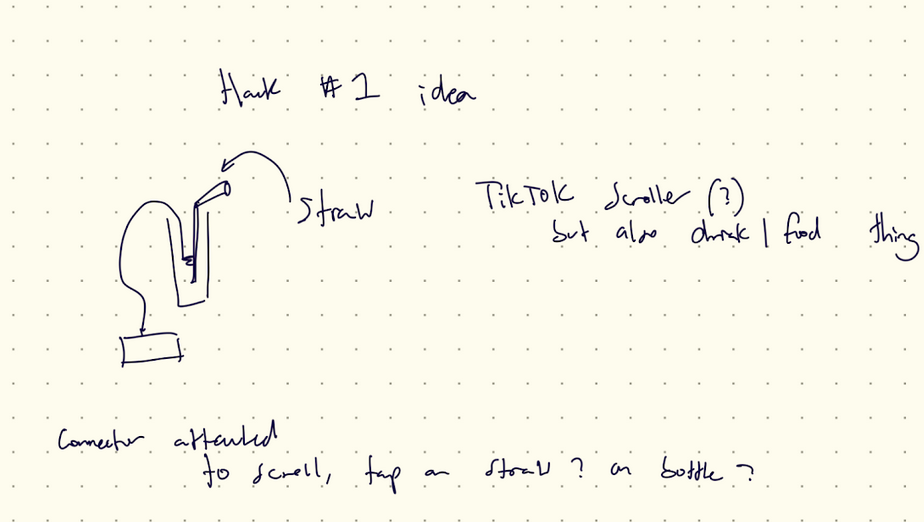
To address this dampening of mental health, I sought to create a solution to an extension of poor mental health – self-care. When being caught up in endless videos, it can be easy to forget simple acts of self-care, such as staying hydrated. One could find themselves going hours without drinking water, too focused on “just one more video” while a water bottle sits untouched. Perhaps this same captivating format could instead remind us to take care of these basic needs, rather than distract from them.
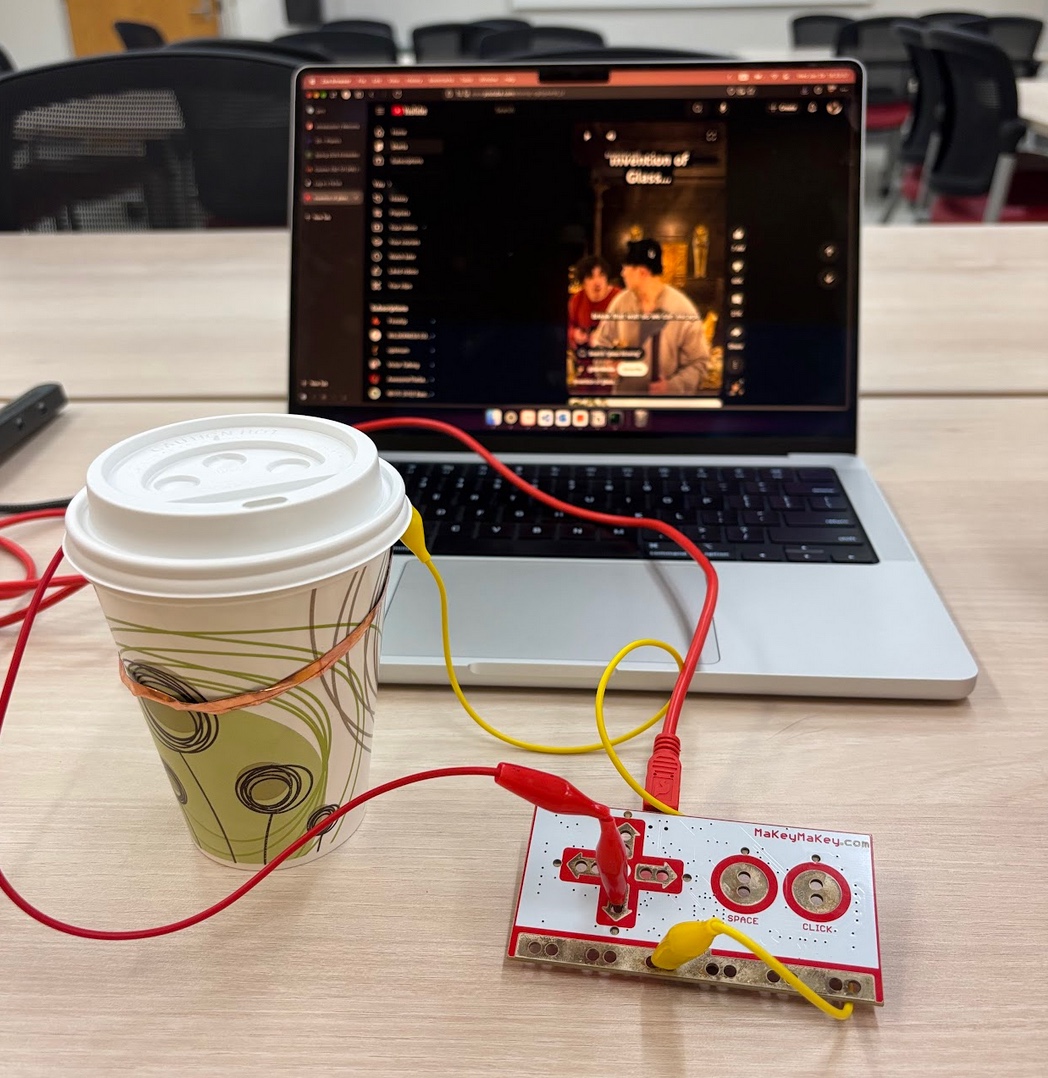
My first hack seeks to take a step in the right direction to offer care while scrolling. Taking a sip of water causes the next video to appear; a person touching the water completes the circuit and causes the MakeyMakey to input a down-arrow keystroke, scrolling to the next video. Albeit a very simple and amateur attempt at solving a much bigger problem, I hope it can serve as a reminder to not get too engrossed in play. Balance in all things is always a necessity, and play is no exception.
Koetsier, John. “‘Digital Crack Cocaine’: The Science Behind TikTok’s Success.” Forbes, 18 Jan. 2020, https://www.forbes.com/sites/johnkoetsier/2020/01/18/digital-crack-cocaine-the-science-behind-tiktoks-success/?sh=26c4916678be.
Richmond Journal of Law & Technology. “TikTok Brain: Can We Save Children’s Attention Spans?” Richmond Journal of Law & Technology, 6 Mar. 2024, https://jolt.richmond.edu/2024/03/06/tiktok-brain-can-we-save-childrens-attention-spans/#_ftn16.
Xie, Jin et al. “The effect of short-form video addiction on undergraduates’ academic procrastination: a moderated mediation model.” Frontiers in psychology vol. 14 1298361. 15 Dec. 2023, doi:10.3389/fpsyg.2023.1298361
